
Article
Will vs Trust: What’s the Difference

Will vs Trust: What's the Difference - and Which One Do You Need?
When planning your legacy, understanding the tools available is key. Two of the most common legal structures are wills and trusts. While they share some purposes, each serves distinct roles and can work together to create a robust estate plan.
Will and Trust
A Will is a legal document that outlines how your assets should be distributed after your death. It allows you to:
- Name beneficiaries for your assets
- Appoint an executor to manage your estate
- Designate guardians for minor children
- Provide funeral and personal directions
However, wills must go through probate, a public court supervised process that can be slow and costly. Probate records also become public, meaning anyone can access details about your estate.
A trust is a legal entity that holds assets on behalf of beneficiaries, managed by a trustee. Trusts come in different forms:
- Revocable (Living) Trusts: Created during your lifetime and can be amended. They bypass probate and provide privacy.
- Irrevocable Trusts: Cannot be altered once set up. They may offer tax and creditor protection.
- Testamentary Trusts: Structured within a will and only take effect at death.
Trust allow control of your assets during and after your lifetime, avoiding prvate, maintaining privacy, and enabling precise distribution, for insteance, staggered payments to minors or financially vulnearable beneficiaries.
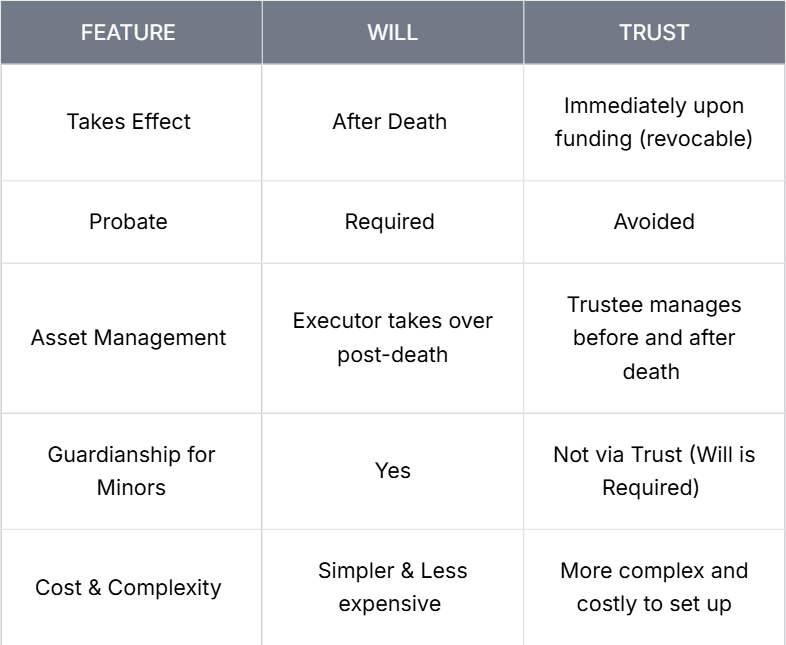
Key Differences
Which One Is More Suitable For You
When it comes to estate planning, a will may be sufficient if your financial affairs are relatively simple, especially if you have a modest estate and minor children. A will allows you to name guardians, outline your wishes, and ensure your assets are distributed according to your intent.
However, for those with larger or more complex estates, a trust may offer significant advantages. Trusts help avoid probate, maintain privacy, provide more control over how and when your assets are distributed, and can ensure continued asset management in the event of incapacity.
In many cases, using both a will and a living trust provides the most comprehensive protection. The trust efficiently manages and transfers your assets, while the will covers guardianship and any assets not included in the trust. To determine what’s best for your unique situation, it's important to consult an experienced estate planning lawyer who can guide you in creating a plan that protects your legacy and supports your loved ones.