
Lasting Power Of Attorney

What is a Lasting Power of Attorney in Singapore?
According to Office of The Public Guardian (OPG), a Lasting Power of Attorney (LPA) is a legal document which allows a person who is aged 21 and above (‘donor’), to voluntarily appoint one or more persons (‘donee(s)’) to make decisions and act on his behalf should he lose mental capacity one day. A donee can be appointed to act in two broad areas of personal welfare and property & affairs matters.
Choosing The Right LPA for Yourself
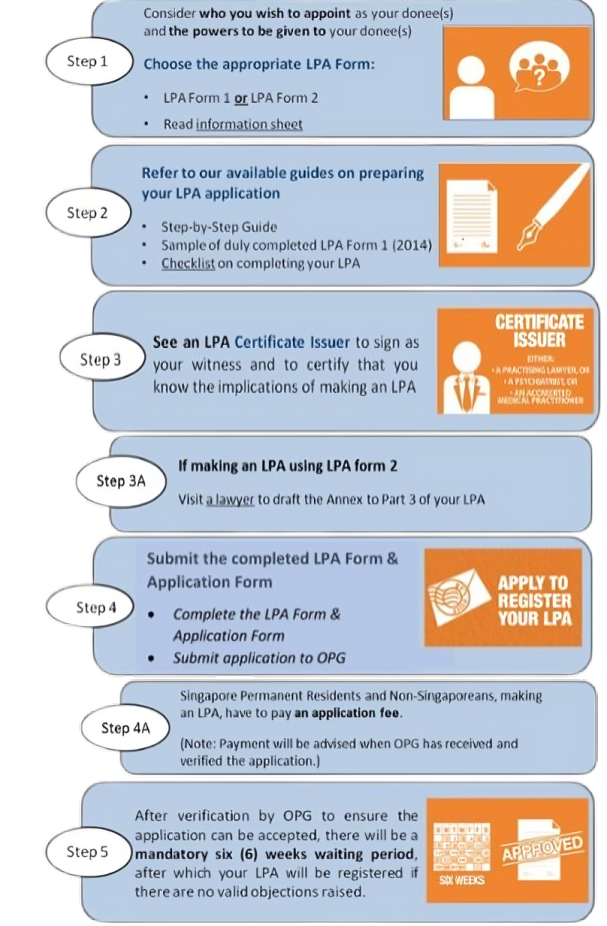
It's essenial to understand the distinction between LPA Form 1 and LPA Form 2, ensuring that your preferences align with the most suitable option. While LPA Form 1 is the preferred and widely utilised option, LPA Form 2 caters to those with unique requirements, offering a tailored and more comprehensive solution for a more intricate and personalised approach to power of attorney.
For those seeking a straightforward approach, LPA Form 1 stands as the go-to standard version. It grants general powers with basic restrictions to the chosen donee or donees.
LPA Form 2 caters to individuals with non-standard requirements. If you wish to bestow customised powers upon your donee or appoint more than two donees, this form is the ideal choice. Notably, LPA Form 2 necessitates professional drafting by a lawyer to ensure precision and adherence to your specific wishes.
LPA Form 2 also extends the flexibility of naming more than one replacement donee. This allows for seamless transitions in case an existing donee passes away, faces financial challenges, or loses mental capacity. Additionally, the donee has the option to notify the OPG if they choose to disclaim their appointment, providing an added layer of control and adaptability in the dynamic landscape of life’s uncertainties.
Should I Appoint You As My Donee?
Its crucial to choose a donee who is not only trustworthy and reliable but also competent to make decisions aligned with the donor decisions
How To Make An LPA
Frequently Asked Questions
The LPA is a legal instrument that allows a person who is at least 21 years of age (donor), to voluntarily appoint one or more persons (donee(s) to make decisions and act on his/her behalf should he/she one day lose mental capacity. A donee can be appointed to act in the two broad areas of personal welfare and property & affairs matters.
You must be at least 21 years old and must have the mental capacity to make the LPA. For the LPA to be valid, it must be registered with the Office of the Public Guardian (OPG).
The best time to make an LPA is while you are still mentally capable of understanding and making decisions for yourself. Mental capacity can be lost unexpectedly through illness, accident, or age-related conditions. Once it is lost, it will be too late to execute an LPA.
Planning ahead by setting up an LPA ensures that your wishes are respected, and the person you trust can step in seamlessly to make decisions on your behalf. It is a proactive and responsible step, one that provides security not just for yourself, but also for your loved ones, who would otherwise face a complicated legal process during an already difficult time.
Your donee may be authorised to make decisions regarding:
1. Personal welfare (including health care decisions) and/or
2. Property & affairs (including finance matters)
Depending on what you have granted him/her. Do note that if a donee is only authorised to make decisions regarding personal welfare, under no circumstance will he/she be authorised to make decisions regarding property & affairs.
Your donee may be authorised to make decisions regarding:
1. Where the donor should live.
2. Who the donor should live with
3. Day to Day decisions (e.g. what to wear and eat)
4. What social activites to take part in
5. Whom the donor may have contact with
6. Handling the donor's personal correspondence
These are just some examples provided by the OPG, it is not an all-inclusive list.
Your donee may be authorised to make decisions regarding:
1. Dealing with property - buying, selling, renting and mortgaging property.
2. Opening, closing and operating bank accounts.
3. Handling tax matters
4. Receiving dividends, income, or other financial entitlements on behalf of the donor
5. Paying the rent, mortgage repayments and household expenses
6. Investing the donor's savings and
7. Purchasing a vehicle or other equipment the donor needs
These are just some examples provided by the OPG, it is not an all-inclusive list.
Creating a Lasting Power of Attorney (LPA) is a vital step in safeguarding your future. It empowers a trusted individual to act on your behalf should you lose mental capacity one day, ensuring that your personal welfare, medical care, and financial matters are managed according to your values and best interests.
An LPA also spares your loved ones the administrative bruden of appling for a court-appointed deputyship . This not only saves significant time and legal costs, but also ensures that decisions can be made swifty during critical moments.
According to OPG, a personal welfare donee must be an individual aged 21 years and above. Donee cannot be a company or business.
A property & affairs donee must fulfill the following conditions:
1. Be an individual who is at least 21 years old when the LPA is signed, or be a licensed trust company as prescribed by the Mental Capacity Regulations.
2. Be an individual who is not an undischarged bankrupt.
If you lose mental capacity before making a Lasting Power of Attorney (LPA), your loved ones will have to apply to the court under the Mental Capacity Act to either make decisions on your behalf or to appoint a deputy to do so.
More importantly, the court-appointed deputy may not be the person you would have personally chosen. At that point, your voice in the matter is effectively lost unless you regain your mental capacity.
While the LPA grants the power to make decisions on behalf of the donor to the donee(s), there are still restrictions in the power granted.
1. Marriage
2. Touching of sexual nature
3. Divorce
4. Abortion
5. Religion
6. Medical Research
7. Advanced Medical Directive
8. Making/Changing of Will
9. Change of gender
10.Sterilisation