
Article
Special Needs Planning and Trusts
A PERSONAL NOTE
My son Alexander was diagnosed with autism at two and a half years old.
That diagnosis changed my life in ways no professional credential could have prepared me for. My wife Corinne gave up her career — and a significant salary — to give Alexander the personal care and consistency he needed. The journey was not linear, and it was never easy.
What it gave me was something no textbook provides: the lived understanding of what ‘planning for a lifetime’ truly means when the beneficiary cannot advocate for themselves. Everything in this section is written from that place — as a father first, and an advisor second.
I call this the Alexander Factor. If it helps even one family build a more secure future for their child, it is worth sharing.
That diagnosis changed my life in ways no professional credential could have prepared me for. My wife Corinne gave up her career — and a significant salary — to give Alexander the personal care and consistency he needed. The journey was not linear, and it was never easy.
What it gave me was something no textbook provides: the lived understanding of what ‘planning for a lifetime’ truly means when the beneficiary cannot advocate for themselves. Everything in this section is written from that place — as a father first, and an advisor second.
I call this the Alexander Factor. If it helps even one family build a more secure future for their child, it is worth sharing.
Why Standard Estate Planning Is Not Enough
For most families, the challenge of estate planning is getting the legal documents right. For families with a special needs member, the challenge is entirely different: how do you ensure that the quality of care, the daily routines, and the dignity of your child’s life are preserved — not just for five years, but for fifty?
Standard wills and nominations cannot answer that question. You need two additional instruments that work in tandem: a trust structure, and a Letter of Intent.
Standard wills and nominations cannot answer that question. You need two additional instruments that work in tandem: a trust structure, and a Letter of Intent.
SNTC Trust versus Private Trust: Choosing the Right Structure
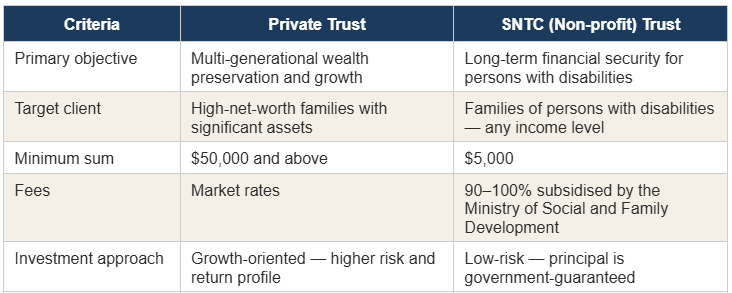
THE DUAL-TRUST STRATEGY
For families with significant assets, I recommend using both structures in tandem. The SNTC Trust holds the baseline maintenance funds — benefiting from the government guarantee and MSF subsidy. A Private Trust manages the larger asset pool for growth, lifestyle provision, and multi-generational wealth succession.
This approach separates financial safety from financial growth, ensuring your child’s core needs are protected regardless of market conditions, while the broader estate continues to work for them over time.
For families with significant assets, I recommend using both structures in tandem. The SNTC Trust holds the baseline maintenance funds — benefiting from the government guarantee and MSF subsidy. A Private Trust manages the larger asset pool for growth, lifestyle provision, and multi-generational wealth succession.
This approach separates financial safety from financial growth, ensuring your child’s core needs are protected regardless of market conditions, while the broader estate continues to work for them over time.
The Special Needs Savings Scheme (SNSS): A Monthly Legacy of Care
Caregivers of dependants with disabilities often fear that a lump-sum CPF payout might be mismanaged or lead to exploitation. The Special Needs Savings Scheme (SNSS), a partnership between MSF and the CPF Board, solves this.
SNSS Benefits for the Beneficiary:
- Monthly Payout Model: Funds are disbursed in fixed monthly amounts rather than a risky lump sum.
- Zero Administrative Fees: Unlike private trusts, the SNSS is free to set up.
- Interest Accrual: Monies remaining in the CPF system continue to earn interest.
- Long-term Security: Ensures a steady stream of income for daily living and medical needs.
While SNSS manages CPF cash, a more robust structure is needed to protect non-CPF assets like insurance and investments.
SNSS Benefits for the Beneficiary:
- Monthly Payout Model: Funds are disbursed in fixed monthly amounts rather than a risky lump sum.
- Zero Administrative Fees: Unlike private trusts, the SNSS is free to set up.
- Interest Accrual: Monies remaining in the CPF system continue to earn interest.
- Long-term Security: Ensures a steady stream of income for daily living and medical needs.
While SNSS manages CPF cash, a more robust structure is needed to protect non-CPF assets like insurance and investments.
The Special Needs Trust (SNT): Guaranteeing a Lifetime of Dignity
The Special Needs Trust (SNT), provided by the Special Needs Trust Company (SNTC), is Singapore’s only non-profit trust service supported by MSF and SG Enable. Effective April 2025, SNTC is a fully owned subsidiary of SG Enable.
The SNT Pathway and Protection
- Affordability: MSF provides up to a 90% subsidy on set-up and activation fees.
- Initial Funding: A trust is established with a $5,000 initial fund.
- Government Guarantee: The principal value of the trust fund is guaranteed by the Government, providing unmatched security.
- The Emotional Heart: The "Letter of Intent" (LOI) acts as the child's compass. It details sensory needs, medical history, and behavioral nuances, ensuring the professional case manager understands the child's daily life as you do.
The SNT Pathway and Protection
- Affordability: MSF provides up to a 90% subsidy on set-up and activation fees.
- Initial Funding: A trust is established with a $5,000 initial fund.
- Government Guarantee: The principal value of the trust fund is guaranteed by the Government, providing unmatched security.
- The Emotional Heart: The "Letter of Intent" (LOI) acts as the child's compass. It details sensory needs, medical history, and behavioral nuances, ensuring the professional case manager understands the child's daily life as you do.
The Letter of Intent: More Important Than Any Legal Document
A trust manages money. But money does not know your child.
The Letter of Intent (LOI) is a non-legal document that I consider the most important thing you will write in your entire estate plan. It is the operating manual for your child’s daily life — the knowledge that lives in your head, that exists nowhere else, and that determines whether the people caring for your child can truly care for them.
What a complete Letter of Intent must cover:
- Dietary needs and allergies — for a child with autism, an undocumented food sensitivity can cause severe distress or a dangerous reaction.
- Daily routines and sensory preferences — the specific rituals and environments that provide comfort and security.
- Social contacts and trusted relationships — who your child knows, who they trust, and who should be involved in their life.
- Medical history and current medications — with dosages, schedules, and the name of every specialist involved in their care.
- Behavioural notes — how your child communicates distress, what calms them, and what should never be done.
- Long-term wishes — the life you want them to have: activities they love, places that matter, the quality of care you expect.
Without this document, your child’s daily happiness depends entirely on the intuition of whoever is caring for them. With it, your love for them outlives you.
The Letter of Intent (LOI) is a non-legal document that I consider the most important thing you will write in your entire estate plan. It is the operating manual for your child’s daily life — the knowledge that lives in your head, that exists nowhere else, and that determines whether the people caring for your child can truly care for them.
What a complete Letter of Intent must cover:
- Dietary needs and allergies — for a child with autism, an undocumented food sensitivity can cause severe distress or a dangerous reaction.
- Daily routines and sensory preferences — the specific rituals and environments that provide comfort and security.
- Social contacts and trusted relationships — who your child knows, who they trust, and who should be involved in their life.
- Medical history and current medications — with dosages, schedules, and the name of every specialist involved in their care.
- Behavioural notes — how your child communicates distress, what calms them, and what should never be done.
- Long-term wishes — the life you want them to have: activities they love, places that matter, the quality of care you expect.
Without this document, your child’s daily happiness depends entirely on the intuition of whoever is caring for them. With it, your love for them outlives you.
The Balancing Act: Fairness to All Your Children
One of the most emotionally complex decisions special needs families face is how to divide an estate equitably when one child requires substantially more financial support than others. Siblings of a special needs child can feel overlooked — and that perception, if not addressed deliberately, can cause lasting damage to family relationships.
My approach integrates a detailed Schedule of Assets and Liabilities with an Investment and Insurance Financial Summary to calculate, precisely, the capital required to fund lifelong care for the special needs beneficiary. The remainder of the estate is then distributed to other children in a manner that is both equitable and clearly explained.
Transparency is the antidote to resentment. When every sibling understands the reasoning, the plan brings families together rather than dividing them.
The $10,000 SNTC Grant: How to Maximize the 2025 Budget Enhancements
The 2025 Budget introduced a landmark support measure: a dollar-for-dollar matching grant of up to $10,000 for SNTC trust accounts.
Strategic Command for Caregivers
This grant is designed to help lower-to-middle-income families build a sustainable "care runway." By matching top-ups, the government effectively doubles the financial protection available for your dependant. Action Plan: Prepare your initial $5,000 funding now. The grant launches later in 2025; acting early ensures you are among the first to benefit from this $10,000 boost.
“This is a precious publication for families with special needs — written from the perspective of a caring, committed father and an experienced professional. It fills a gap that no other resource in Singapore currently addresses.”
— Calvin Chew, Senior Manager, Autism Resource Centre Singapore