
Article
LPA and Advance Medical Directive

Why LPA is Important
Three days after his stroke, Mr Tan's daughter realised something terrifying.
Nobody could legally access his bank account.
Nobody could manage his medical decisions.
And despite being his closest family member, she had no automatic authority to act for him.
This is the moment many Singaporean families discover the importance of a Lasting Power of Attorney (LPA).
Nobody could legally access his bank account.
Nobody could manage his medical decisions.
And despite being his closest family member, she had no automatic authority to act for him.
This is the moment many Singaporean families discover the importance of a Lasting Power of Attorney (LPA).
The Lasting Power of Attorney (LPA)
We plan for birth. We plan for retirement. Very few of us plan for the years between — when we may still be alive but no longer in control of our own decisions.
Medical technology has extended Singaporean lifespans significantly. But longevity without a plan transfers the burden of your hardest decisions to the people you love most, at the moment they are least equipped to carry it.
Two documents prevent this. Neither takes long to complete. Both require that you are healthy when you apply.
An LPA is a legal document in which you (the Donor) appoint someone you trust (the Donee) to make decisions on your behalf if you lose mental capacity. It covers two domains: your personal welfare, and your property and financial affairs.
Critical: you must apply while you are mentally capable. There is a mandatory six-week waiting period before registration takes effect. Once capacity is lost, the opportunity to file an LPA is gone — and your family must seek a court order instead, which is significantly more costly, slow, and stressful.
LPA Form 1 vs. LPA Form 2
Medical technology has extended Singaporean lifespans significantly. But longevity without a plan transfers the burden of your hardest decisions to the people you love most, at the moment they are least equipped to carry it.
Two documents prevent this. Neither takes long to complete. Both require that you are healthy when you apply.
An LPA is a legal document in which you (the Donor) appoint someone you trust (the Donee) to make decisions on your behalf if you lose mental capacity. It covers two domains: your personal welfare, and your property and financial affairs.
Critical: you must apply while you are mentally capable. There is a mandatory six-week waiting period before registration takes effect. Once capacity is lost, the opportunity to file an LPA is gone — and your family must seek a court order instead, which is significantly more costly, slow, and stressful.
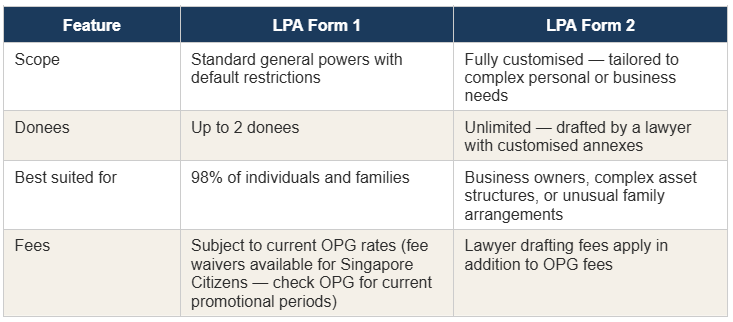
LPA Form 1 vs. LPA Form 2
THE STRATEGIC RISK: DECISION-MAKING PARALYSIS
Appointing multiple Donees without clear instructions on how they must agree can create paralysis — or worse, family conflict — at the moment a decision is most urgent. If you appoint two Donees, specify whether they must act jointly, or whether either may act independently.
Appointing multiple Donees without clear instructions on how they must agree can create paralysis — or worse, family conflict — at the moment a decision is most urgent. If you appoint two Donees, specify whether they must act jointly, or whether either may act independently.
The Advance Medical Directive (AMD)
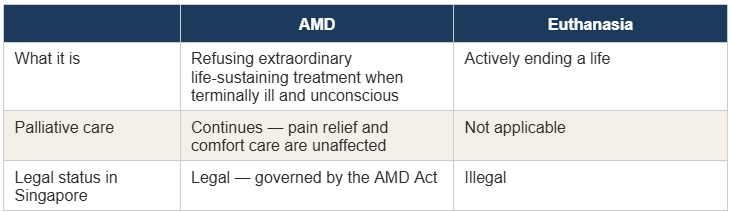
The AMD is a legal document in which you inform your doctor, in advance, that you do not wish to receive extraordinary life-sustaining treatment if you are terminally ill and unconscious — with no reasonable prospect of recovery.
It is one of the most compassionate decisions you can make for your family.
THE GUILT CYCLE — AND HOW THE AMD DISSOLVES IT
In our Asian family culture, children feel a profound emotional burden when asked to decide whether to continue aggressive medical intervention for a parent who cannot speak for themselves. The guilt of ‘letting go’ — even when it is the right and humane decision — can fracture families and cause lifelong regret.
The AMD removes that burden. You make the decision while you are well. Your children honour it, rather than make it.
AMD versus Euthanasia: a necessary distinction
It is one of the most compassionate decisions you can make for your family.
THE GUILT CYCLE — AND HOW THE AMD DISSOLVES IT
In our Asian family culture, children feel a profound emotional burden when asked to decide whether to continue aggressive medical intervention for a parent who cannot speak for themselves. The guilt of ‘letting go’ — even when it is the right and humane decision — can fracture families and cause lifelong regret.
The AMD removes that burden. You make the decision while you are well. Your children honour it, rather than make it.
AMD versus Euthanasia: a necessary distinction
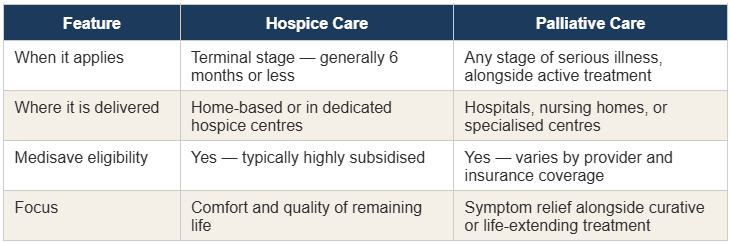
Planning for Where You Die: Hospice and Palliative Care
A striking 77% of Singaporeans express a wish to die at home. The majority do not achieve this — not because it is impossible, but because no care plan was established in advance. Home-based palliative care requires specialised nursing, equipment, and coordination that cannot be arranged at the last moment.
“Andrew Ang’s approach is comprehensive and easy to read. I encourage everyone to act before illness strikes, to avoid the ‘hurried’ and deeply uncomfortable journey that so many families experience when they have not planned.”
— Dr. See Hui Ti, Senior Consultant, Parkway Cancer Centre