
Article
Wills & the Intestate Succession Act

A True Story
In April 2017, I sat beside my friend A.K. in a hospital ward, helping him sign his will from a hospital bed. He had just been diagnosed with liver cancer. He had one month to live.
The signing had to be recorded on video to protect against future legal challenges. His final days — which should have been spent with family, in peace — were consumed by the distress of paperwork he had delayed for years.
A.K. did not fail to love his family. He simply ran out of time to protect them.
This guide exists so that does not happen to yours.
The signing had to be recorded on video to protect against future legal challenges. His final days — which should have been spent with family, in peace — were consumed by the distress of paperwork he had delayed for years.
A.K. did not fail to love his family. He simply ran out of time to protect them.
This guide exists so that does not happen to yours.
Why Singaporeans Delay — and What It Costs
Estate planning is surrounded by a silence that feels almost cultural. In our community, speaking about death can feel like tempting fate. Many families assume that love is enough — that their wishes are understood, their intentions clear.
But the law does not read intentions. It reads documents. And when no document exists, Singapore’s Intestate Succession Act (Chapter 146) steps in — blind to your relationships, your debts of gratitude, and your hopes for your children’s future.
In my 25 years as a director in a financial planning firm, I have sat across from too many grieving families navigating a system that was designed for order, not for love. The difference between those who emerged with their finances intact and those who did not was rarely about wealth. It was about whether a will existed.
But the law does not read intentions. It reads documents. And when no document exists, Singapore’s Intestate Succession Act (Chapter 146) steps in — blind to your relationships, your debts of gratitude, and your hopes for your children’s future.
In my 25 years as a director in a financial planning firm, I have sat across from too many grieving families navigating a system that was designed for order, not for love. The difference between those who emerged with their finances intact and those who did not was rarely about wealth. It was about whether a will existed.
What the Law Decides When You Don’t
If you die intestate — without a valid will — the following rules determine who receives everything you have built. Study this table carefully. Most families are shocked by the implications of Rule 2.
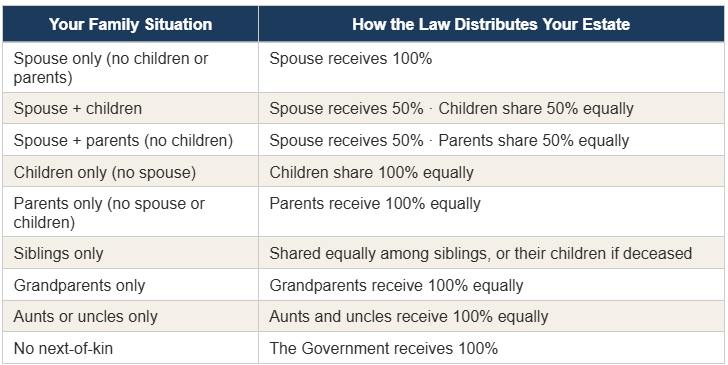
Note: These rules do not apply to Muslims, who are governed by Syariah Law.
THE IMPLICATION MOST FAMILIES MISS
Look again at the row for Spouse + children. If you have a surviving spouse and children, your parents receive nothing — regardless of what they sacrificed for you.
For many Singaporean families, this directly contradicts our deepest values. For example, my own parents gave up their entire retirement fund to ensure I could complete my engineering degree. Without a will, I would have been legally unable to repay that sacrifice.
The law is blind to your gratitude.
Your will is not.
The True Cost of Procrastination: What A.K.’s Family Faced
Because A.K. required emergency drafting assistance, his family encountered a cascade of financial and legal penalties that a simple, earlier decision would have prevented entirely.
FINANCIAL PENALTIES OF A LAST-MINUTE WILL
Emergency premium. Service providers charge significantly higher fees for rushed drafting. What would have cost a few hundred dollars took years off A.K.’s family’s savings.
Probate disparity. Quotes for probate assistance ranged from $1,200 to $5,000 — a range that reflects desperation, not value. Without a will, families must apply for a Letter of Administration, which requires administration bonds, is more complex, and takes significantly longer.
The insurance trap. Under Section 61 of the Insurance Act, an insurer can only pay up to $150,000 directly to a ‘proper claimant’ if no valid nomination exists. Any amount beyond this is frozen in the estate administration process — potentially for years — leaving the family cash-poor at their most vulnerable moment.
FINANCIAL PENALTIES OF A LAST-MINUTE WILL
Emergency premium. Service providers charge significantly higher fees for rushed drafting. What would have cost a few hundred dollars took years off A.K.’s family’s savings.
Probate disparity. Quotes for probate assistance ranged from $1,200 to $5,000 — a range that reflects desperation, not value. Without a will, families must apply for a Letter of Administration, which requires administration bonds, is more complex, and takes significantly longer.
The insurance trap. Under Section 61 of the Insurance Act, an insurer can only pay up to $150,000 directly to a ‘proper claimant’ if no valid nomination exists. Any amount beyond this is frozen in the estate administration process — potentially for years — leaving the family cash-poor at their most vulnerable moment.
Why Downloaded Templates Are Dangerous
A valid will for Singapore’s probate courts is a precise legal instrument, not a form to complete. I have seen families discover — at the worst possible moment — that a template they downloaded from a generic website contained errors that rendered the entire document invalid.
An invalid will is legally worse than no will at all. It gives a false sense of security while creating grounds for litigation. The cost of professional drafting is a fraction of the cost of contested probate.
An invalid will is legally worse than no will at all. It gives a false sense of security while creating grounds for litigation. The cost of professional drafting is a fraction of the cost of contested probate.
The Five Roles Every Valid Will Must Define
A robust estate plan is built around five clearly defined roles. Missing even one can expose your family to legal challenge or unintended outcomes.
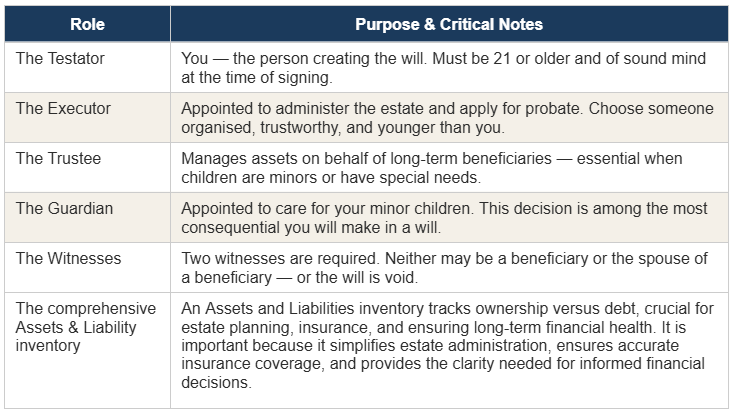
TWO CLAUSES THAT PREVENT PARTIAL INTESTACY
Every professionally drafted will should include a Residuary Clause — covering assets acquired after the will was written — and an Attestation Clause, confirming that the testator was of sound mind when signing. Without these, any assets not specifically listed revert to the ISA’s default rules, creating a ‘partial intestacy’ that defeats the purpose of the document.
Every professionally drafted will should include a Residuary Clause — covering assets acquired after the will was written — and an Attestation Clause, confirming that the testator was of sound mind when signing. Without these, any assets not specifically listed revert to the ISA’s default rules, creating a ‘partial intestacy’ that defeats the purpose of the document.
“I can tell you from personal experience — there is no sleep that comes easier than when we know our affairs are in order and our loved ones taken care of.”
— Tony Gordon, Past President, Million Dollar Round Table (MDRT)T)
— Tony Gordon, Past President, Million Dollar Round Table (MDRT)T)